Laboratory Resources
Our laboratory is well equipped for a wide range of experiments and computational modeling.
Behavioral Research: Our laboratory has two large rooms equipped with computers for testing human participants in experiments. Our laboratory also has a meeting room with a large conference table and workspace.
Data Analysis. We have several desktop computers equipped with a wide range of software for data analysis and presentation.
Computational Modeling. We make use of the high performance computing facilities at Vanderbilt’s Advanced Computing Center for Research and Education (ACCRE). ACCRE currently maintains a compute cluster with over 10,000 processing cores, a large GPU cluster, and a near-petabyte storage system.
Our laboratory also has two Dell Precision workstations, both of which are equipped with dual multi-core Xenon processors, one of which is equipped with two P100 GPU cards, the other of which is equipped with two 2080Ti GPUs. We also share a Dell Precision dual-processor/40-core/P100 workstation with other labs; this workstation also serves as a gateway to a shared 200TB file server.
Online Web-based Experiments. We have an NEC workstation that serves as a web server for online experiments and hosts laboratory web sites as well as serves an additional compute node for modeling.
Eye Tracking. Our laboratory shares two SR Research EyeLink eye tracking system.
Data, Models, and Supplemental Information
We are just begining to archive data and supplemental information from our publications. More will come later (I’d say soon, but I’d be lying).
Click here for supplemental information for Folstein, Gauthier, and Palmeri, How Category Learning Affects Object Discrimination: Not all Morphspaces Stretch Alike.
Click here for supplemental information for Folstein, Gauthier, and Palmeri, Mere Exposure Facilitates Learning of Novel Objects.
Click here for supplemental Information for Richer, Gauthier, Wenger, and Palmeri, Holistic Processing of Faces: Bridge Paradigms.
Working simulations of the independent race model and the interactive race model described in Boucher, Palmeri, Logan and Schall, Inhibitory Control of Mind and Brain: An Interactive Race Model of Countermanding Saccades can be found at http://www.psy.vanderbilt.edu/faculty/palmeri/psyrev07_model/.
Working simulations of the Gated Accumulator model described in Purcell, Heitz, Cohen, Logan, Schall, and Palmeri, Neurally Constrained Modeling of Perceptual Decision Making can be found at http://catlab.psy.vanderbilt.edu/wp-content/uploads/PurcellHeitzCohenLoganSchallPalmeri_PublicCode1.zip
Institutional Resources and Research Centers
Our research is enhanced by our affiliation with research centers that provide important funding and support for research infrastructure.
Temporal Dynamics of Learning Center (TDLC). Our laboratory is part of the Perceptual Expertise Network (PEN), which is now one of four research networks in a new NSF funded Science of Learning Center devoted to studying the role of time and timing in human learning. The center funds some of our research as well as network activities of PEN.
Perceptual Expertise Network (PEN). PEN is a collaborative research network working together to explore how different brains approach object recognition and categorization.
Advanced Computing Center for Research and Education (ACCRE). ACCRE is the high performance computing center at Vanderbilt. It supports a cluster of well over 1000 processors on linux computers that we regularly use in our computational modeling research.
Center for Integrative and Cognitive Neuroscience (CICN). CICN provides important administrative and computer support for many aspects of the research done in our laboratory.
Vanderbilt Vision Research Center (VVRC). The VVRC provides our laboratory administrative, computer, and graphics design support.
Vanderbilt University Institute for Imaging Science (VUIIS). VUIIS supports a 3T and 7T research-only MR scanner for human brain imaging research at Vanderbilt.

Picture taken at an OPL-CATLAB meeting at which Anders Ericsson visited.
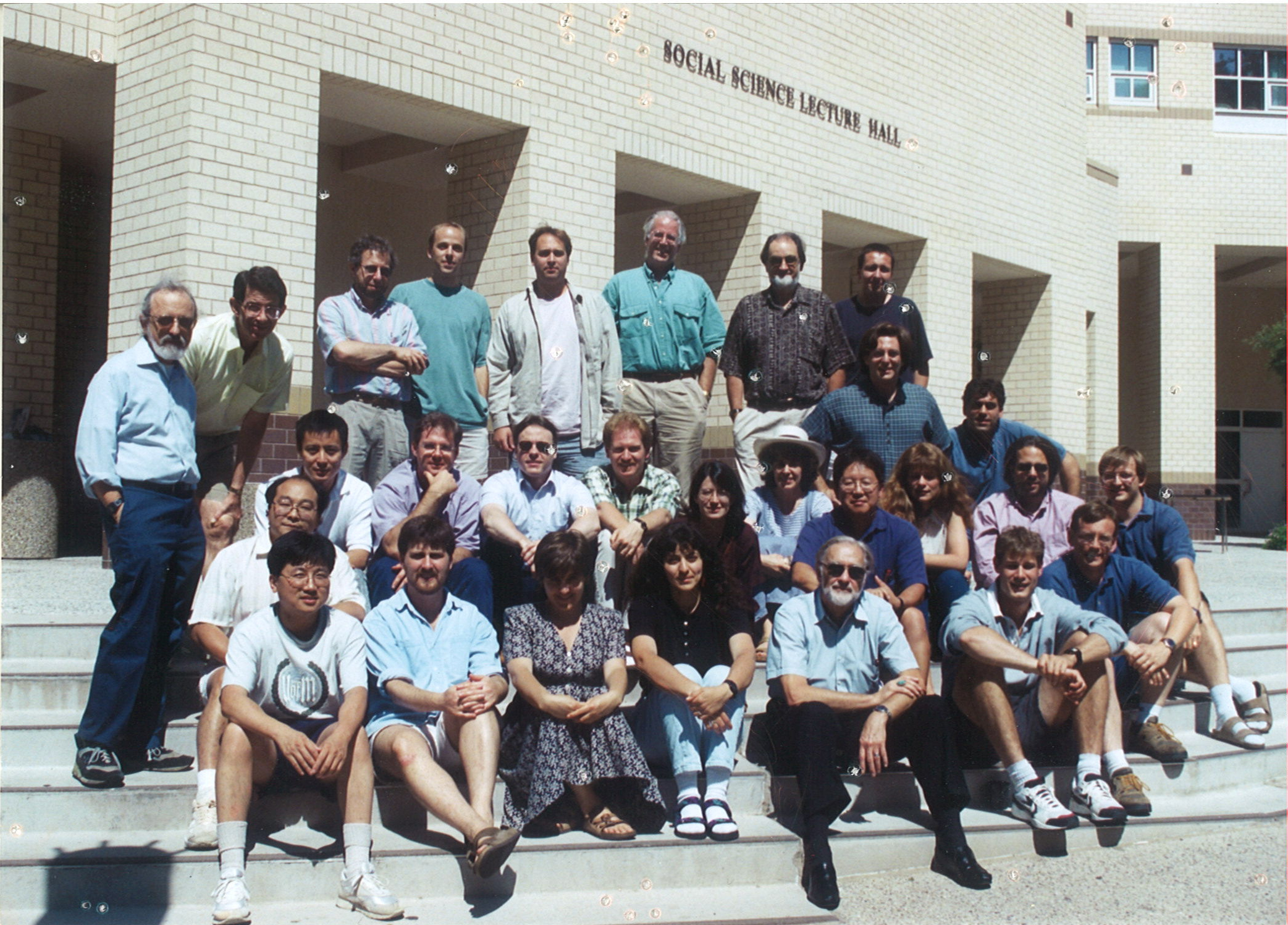
Picture taken at the 1997 summer workshop on Mathematical Psychology at UC Irvine, hosted by Duncan Luce (sitting front row, center right).
Click here for a larger version of the mosaic.
To the tune of Dreadlock Holiday
Lyrics by Suzie Dukic (with help from Mike Mack)
I was walkin’ down the street
Concentratin’ on truckin’ right
I heard a smart voice beside of me
And I looked round in a state of fright I
saw four scientists, one mad
The others from the gutter
They looked me up and down a bit
And turned to each other
I say I don’t like science oh no, I love it
I don’t like research no no, I love it
They said,
Don’t walk away yet
You got to show some respect
We have our doctorates
And you’re prosopagnosic
They said come back to the lab with us
They said we’ll give you some dollars
I said I don’t know my cars, man
And I’m afraid that I might holla
They said we like you, we want you
We need you for our research
You’ll see faces and greebles
While we record your blood flow properties
And EEG’s…..and I say!
I don’t like science oh no,
I love it
I don’t like research no no,
I love it
They said don’t walk away yet
You got to show some respect
We’ve got millions in grants
And a posse of students
I hurried back to the Hard Rock
Sinkin Pina Colada
I heard Gary beside me say
Would you like something harder
He said I’ve got it, you want it,
My Models are the best, and if you try ’em
You’ll like ’em, and wallow in the Research Holiday
Don’t like the Hard Rock, oh no, I love her
Don’t like Chicago, no no, I love her
He said don’t you walk away yet
Got to show some respect,
Don’t you walk away yet,
Cause you ain’t seen the owls yet
Don’t like the PI’s, no no, I love them,
Don’t like the trainees, ohhh,
I love them,
I love the Science!